Docs / Funnel leak diagnosis
What runs when you ask where your funnel leaks
Walks the funnel step by step, finds the biggest drop, then splits that step by segment to find who actually dropped.
Signature
cr_get_funnelThe step-by-step funnel with the conversion rate at each step, the biggest leak, and the next N leaks.cr_diagnose_funnel_dropGiven a current and a prior period, which segments contributed most to the drop or the rise.cr_get_landing_pagesTop landing pages with sessions, engagement rate, bounce rate and average session duration.
What you ask
- Where is my funnel leaking the most, and which segment is actually dropping?
- Show the whole funnel as a table: step, users, step conversion rate, drop-off. No commentary.
What runs
What comes back
Where is my funnel leaking the most, and which segment is actually dropping?
The biggest leak is product view → add to cart: • 42,879 product views → 861 adds to cart • Only 2.0% progress, a 98.0% drop-off The segment driving the overall conversion decline is United States traffic: conversion fell 58.8%, from 0.72% to 0.30%, across 55,938 sessions. By source, Direct / None dropped hardest: −73.9%. Traffic quality looks clean, so this appears to be a real funnel problem rather than analytics noise.
Show the whole funnel as a table: step, users, step conversion rate, drop-off. No commentary.
Page view 106,226 — — View item 42,879 · 40.37% step conversion · 59.63% drop-off Add to cart 861 · 2.01% · 97.99% Begin checkout 269 · 31.24% · 68.76% Purchase 107 · 39.78% · 60.22%
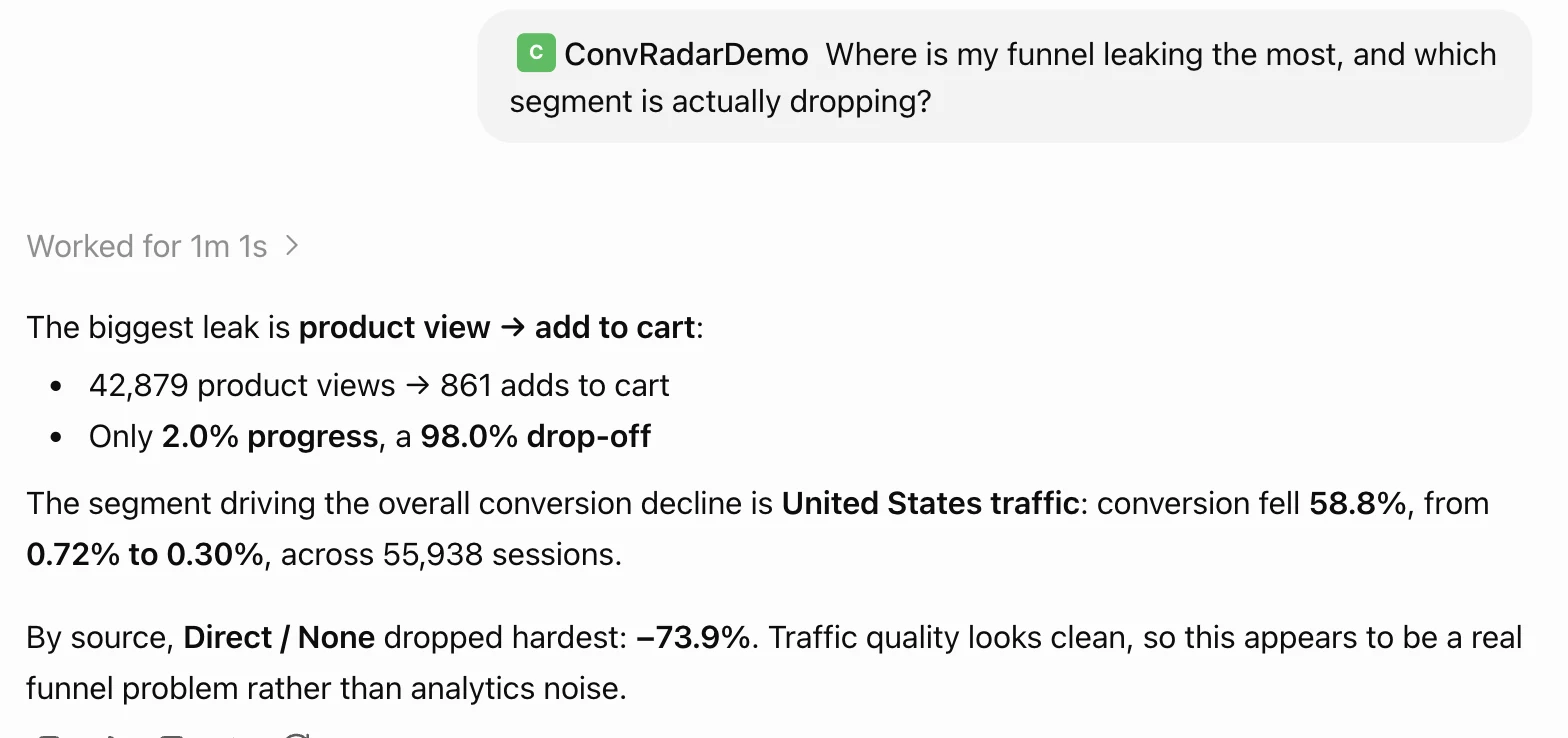
ChatGPT · GPT-5.6 Sol · captured 2026-08-03 · Demo Shop, data window 2026-03-28 to 2026-08-02
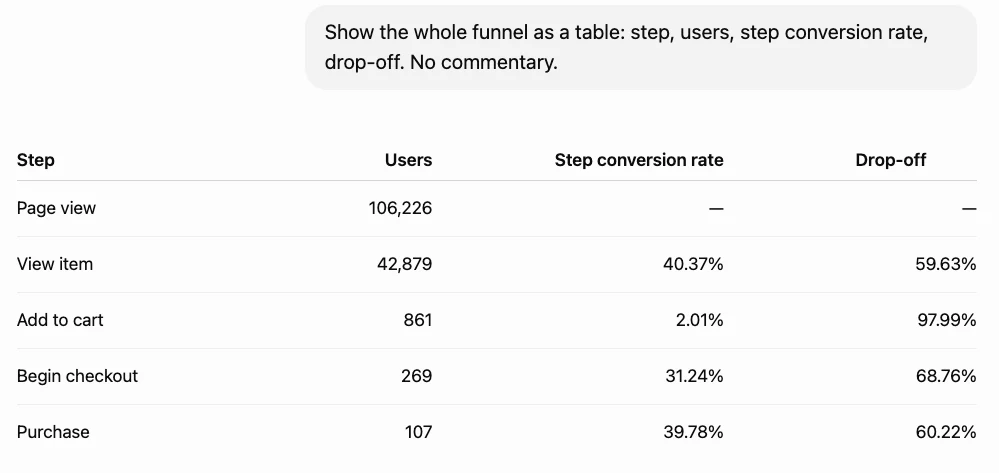
ChatGPT · GPT-5.6 Sol · captured 2026-08-03 · Demo Shop, data window 2026-03-28 to 2026-08-02
When to reach for this
Use this when you know conversion is bad but not where
This is the instrument for "we convert at 0.4% and I do not know which step is eating it". It walks every step you send and ranks the losses, so you get a place to stand before you get an opinion. If you already know the step and want to know why it fails, you are one instrument further on: check the page instead.
Not this one if the number moved suddenly
A funnel read tells you where volume is lost on average across the window. It does not tell you that something broke on a Tuesday. When the question is "why did it drop" rather than "where does it leak", anomaly detection is the right starting point: it scans daily metrics for statistically significant breaks and then checks whether the traffic behind them changed. Run the funnel afterwards to see which step absorbed the loss.
Not this one if you already suspect a specific audience
The segment split here is a follow-on: it decomposes the worst step to find who was responsible. If you arrive already knowing you want mobile against desktop, or paid against organic, on the same metrics with a significance test, segment comparison answers that directly and in one call rather than three.
How to read it
A 98% drop is not the finding. The comparison is.
Product view to add-to-cart is the widest step in almost every store, and a two percent pass rate on it is unremarkable on its own. What makes it the answer here is the table above: every other step in this funnel loses between 59% and 69%, and this one loses 98%. That is the comparison doing the work, not the absolute number. Read the step ranking first, or you will spend a quarter fixing the step that was always going to be the narrowest. Note also that begin-checkout to purchase converts at 39.78%, which is healthy: the money here is on the product page, not in the checkout.
Two different questions get answered, and they have different answers
"Where does the funnel leak" and "what caused the decline" are separate questions, and the tools behind them are separate too. The leak is a step: product view to add-to-cart. The decline is a segment measured against the prior period: United States traffic, 0.72% down to 0.30%. The step with the biggest leak is not automatically where the drop came from. When the answer names both, treat them as two findings, not one.
Why it checks traffic quality before it trusts the funnel
The run scores the property for referral spam, internal and test traffic before reading the funnel at all. Noise lands almost entirely on the first transition, so a dirty property shows a spectacular view-to-cart collapse that is really a tracking artefact. When the answer says traffic quality looks clean, that sentence is doing work: it is the reason the numbers above it are worth acting on.
"Direct / None" is a warning label, not an audience
A large cohort with no source attached is usually an attribution blind spot rather than a real group of people: stripped UTM parameters, an app webview, a redirect that lost the referrer. So a headline like "Direct / None dropped hardest, −73.9%" is a prompt to check tagging first and page design second. If you rebuild a product page because of a number attached to Direct / None, you may be fixing a page that was never the problem.
Limits
- It reads the funnel your property actually sends. No view_item or add_to_cart events, no funnel, and the answer will say so rather than invent steps.
- The segment split answers who dropped against the prior period, not who converts worst overall. Those are different questions and a weak-but-stable segment will not appear here.
- It never looks at the page. It can tell you the step is leaking and who is leaking through it, not why the page fails. Pair it with visual proof or a page check for that half.
- Numbers come from the connector's synced GA4 tables, not a live query, so a change you shipped this morning will not show up yet.
- The run above took about a minute. Several tools fire in sequence, and a client that streams its thinking will show that as a pause.
Related instruments
Go deeper
Try it on your own data
Every instrument runs on your own GA4, read-only, inside Claude or ChatGPT. One connector covers all of them.
Add the connector →Session captured 2026-08-03 against the ConvRadar demo property. Masked in the image: cropped to the conversation column, so the account sidebar and workspace name are out of frame, no connector URL is in frame, so no token can leak, no account email or avatar is in frame.