Docs / Hypothesis library
Where the fixes come from, and why they are not opinions
A curated catalogue of CRO hypotheses built from published research. Every finding is matched to one, and you can mark what you are testing so the next session resumes.
Signature
cr_list_hypothesesBrowse the hypothesis catalogue, filtered by CRO category or by industry vertical.cr_get_hypothesisThe full content of one hypothesis by id: description, applicable verticals, and the research behind it.cr_mark_hypothesis_statusMarks a hypothesis surfaced, testing, confirmed, rejected, dismissed or archived for this account.cr_save_ai_suggestedStores a model-generated hypothesis when nothing in the library matches the finding.
What you ask
- My product pages lose almost everyone before add to cart. What does the CRO hypothesis library have for that? Show the matching hypotheses as a table with the id, the title, the category and the expected impact.
What runs
What comes back
My product pages lose almost everyone before add to cart. What does the CRO hypothesis library have for that? Show the matching hypotheses as a table with the id, the title, the category and the expected impact.
The library has 23 direct matches for a weak product-view to add-to-cart step. I filtered out hypotheses aimed mainly at checkout, AOV or acquisition. H-PDP-009 — Add-to-cart button below mobile fold with no sticky-bottom bar — mobile_pdp_ux — 10 to 30% lift in mobile add-to-cart rate H-PDP-002 — No product video, or video buried below the fold — pdp_visual — 8 to 25% lift in add-to-cart rate H-PDP-031 — PDP sells features rather than outcomes and stakes — pdp_social_proof — 8 to 25% lift in add-to-cart rate H-PDP-001 — Fewer than 4 to 6 product images or missing key image types — pdp_visual — 6 to 20% lift in add-to-cart rate H-PDP-012 — Reviews missing, too few, suspiciously perfect, or no aggregate rating — pdp_social_proof — 5 to 20% lift in add-to-cart rate H-PDP-022 — No compatibility, sizing, or fit guide — pdp_information — 5 to 20% lift in add-to-cart rate H-PDP-010 — Price separated from ATC, hidden on mobile, or covered by popups — pdp_pricing — 5 to 18% lift in add-to-cart rate H-PDP-003 — No estimated delivery date on the PDP — pdp_trust — 5 to 18% lift in add-to-cart rate The strongest matches cluster around missing decision information, weak pricing visibility, thin reviews and unclear delivery or returns.
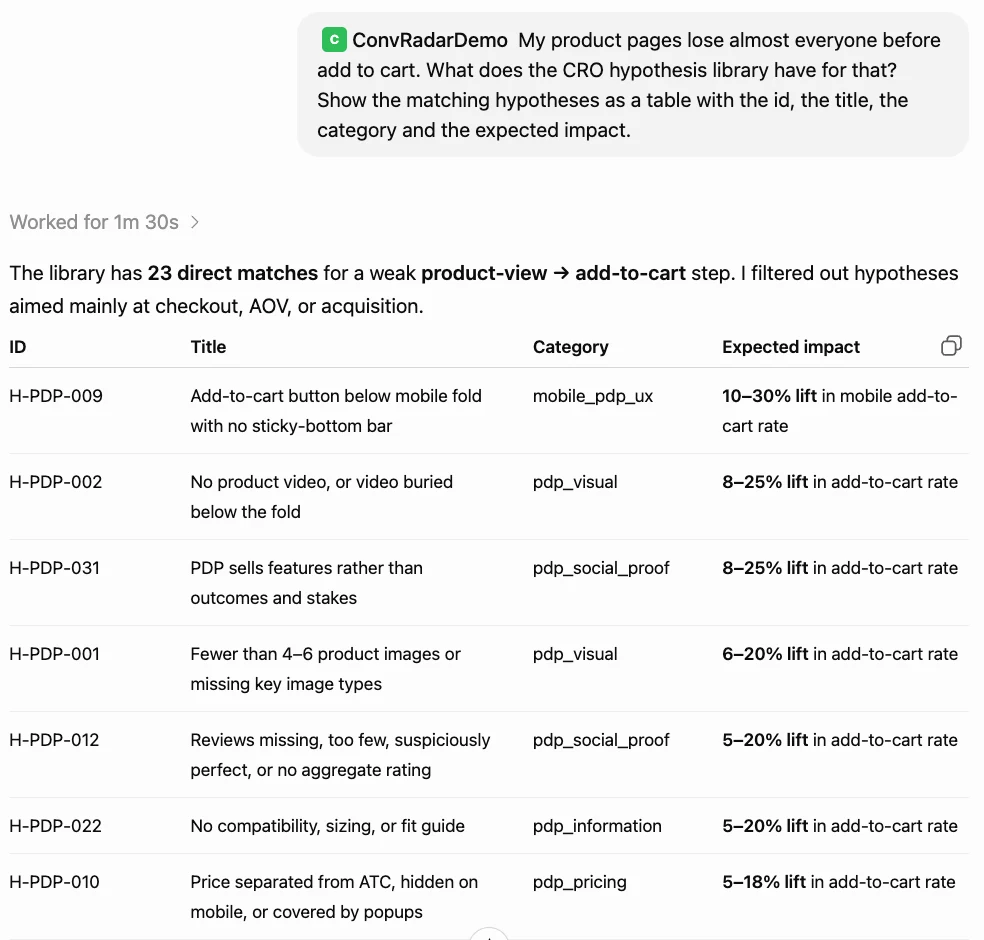
ChatGPT · GPT-5.6 Sol · captured 2026-08-03 · Demo Shop, data window 2026-03-28 to 2026-08-02
When to reach for this
Use this once you know which step is failing
The library is indexed by failure, not by page. You bring a broken step, it returns the researched reasons that step usually breaks, ranked by expected effect. Coming here before you have a diagnosis produces a reading list rather than a plan.
Use it to stop the brainstorm
The most expensive part of most CRO programmes is the meeting where everyone proposes a favourite idea. Twenty-three researched candidates with impact ranges attached ends that meeting faster than any argument, because the question changes from what should we try to which of these applies to us.
Not this one for a verdict on your own page
The library says what tends to break this step across many stores. Whether your page has the problem is a separate question, and visual proof or a page check is what answers it.
How to read it
The categories are the real structure
Eight results, seven different categories: mobile_pdp_ux, pdp_visual, pdp_social_proof, pdp_information, pdp_pricing, pdp_trust. A weak add-to-cart step is not one problem, it is six unrelated problems that produce the same number. Reading the category column tells you which specialist to involve before you read a single title.
Impact ranges are priors, not promises
A range like 10 to 30% comes from published research across many stores, not from your property. It is a prior that helps you order candidates, and it will be wrong for you in both directions: a fix for a problem you do not have returns zero, and a fix for one you have badly can beat the top of the range.
Notice what it filtered out
The answer says it excluded hypotheses aimed at checkout, AOV and acquisition. That filtering is the point of matching against a diagnosed step: without it you get the whole catalogue and no ordering. If the filter looks wrong, the fix is to correct the diagnosis rather than to widen the search.
Ranked by expected lift is not ranked by what to do first
The top entry is a mobile sticky add-to-cart bar. If your traffic is desktop-heavy, that top-ranked item is close to worthless for you, and the fifth entry about thin reviews may be the real one. Multiply each range by the share of traffic it can touch before you order the backlog.
Limits
- The library describes patterns from published conversion research. It is a starting hypothesis set, not evidence about your site.
- Impact ranges are drawn from other people's tests. Treat them as ordering information, not as a forecast for your traffic.
- Matching depends on a correctly diagnosed step. A wrong diagnosis returns a confident and irrelevant list.
- Marking a hypothesis as testing or confirmed stores state for your account so later sessions resume, but nothing here runs or measures the test for you.
Related instruments
Go deeper
Try it on your own data
Every instrument runs on your own GA4, read-only, inside Claude or ChatGPT. One connector covers all of them.
Add the connector →Session captured 2026-08-03 against the ConvRadar demo property. Masked in the image: cropped to the conversation column, so the account sidebar and workspace name are out of frame, no connector URL is in frame, so no token can leak, no account email or avatar is in frame.