This afternoon I ran a review-mining pass on my own homepage. The most frequent complaint in my category — raised half again as often as the runner-up — was "tools give me data with no actionable next step." My page's verdict on that pain: said poorly. My hero says "find what's leaking," and never once contrasts it with the thing people are actually sick of.
I build a conversion tool for a living. I write about message-match for a living. And the most common pain in my own market was sitting in my copy at half volume.
That's what review mining is for. It's the practice of pulling customer language out of existing public reviews and discussions — the pains, desires and objections people volunteer when nobody's surveying them — and using it as raw material for your page copy. No panel, no interviews, no waiting for survey responses. The words already exist. You go get them.
The spreadsheet method, and the three places it breaks
Copywriters have done this manually for a decade. The canonical version comes from Copyhackers: read 500+ Amazon reviews of books your prospects read, sort quotes into a spreadsheet of what they love, hate and worry about, pull the sharpest lines. It produced one of the most famous headlines in CRO — "If you think you need rehab, you do" — which beat the control by 400% on clicks. Wynter's version is lighter: 50–100 reviews, about two hours, bucket by jobs-to-be-done.
The method works. I've done it for client audits and it beats guessing every time. But after enough passes you notice three structural problems.
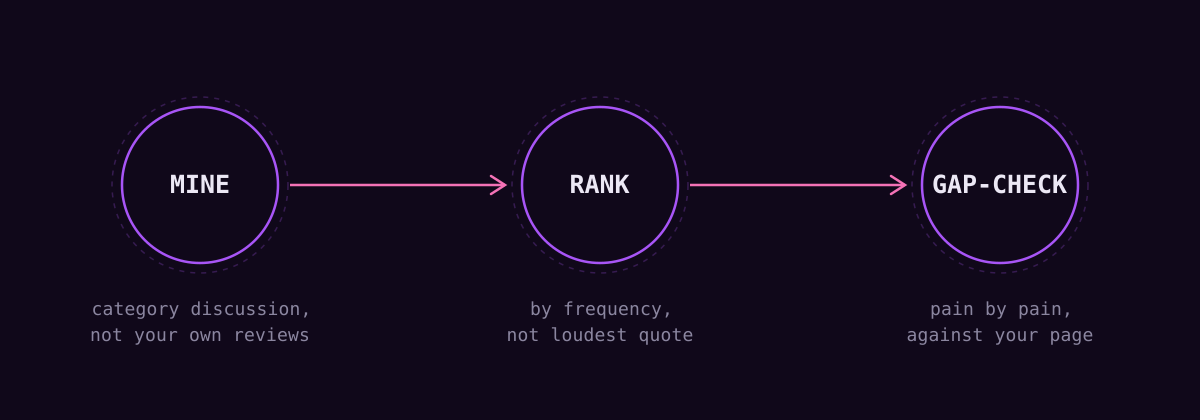
Start with whose reviews get mined. Most people mine their own — and that's survivor data. Your reviewers are the people your current message already converted; they'll echo your positioning back at you and you'll conclude the copy is fine. The pains that stop everyone else never show up, because those people left without writing anything. The unbiased material lives in category discussion: Reddit threads, Quora answers, niche forums and social threads where nobody is reviewing you.
Ranking is the next break. A spreadsheet of 80 quotes has no way to tell you which pain is the market's #1 and which one is a single loud person. The sharpest-sounding quote wins the argument, and the sharpest quote is not the most common one.
And the process ends at the spreadsheet. You have the pains. Nobody makes you walk your actual landing page against them, pain by pain, and write down the verdict. That last step is where the copy changes come from, and it's the step every guide skips.
How to run it manually
Pick the category conversation, not the brand pages. For a project-management tool that means r/projectmanagement and r/smallbusiness, not your G2 profile. Competitor review pages are fair game — their unhappy customers are your best copywriters.
Collect until themes start repeating — usually 60–100 raw snippets. Tag each one as a pain, a desire or an objection, then count. The count is the whole point: frequency turns a pile of quotes into a priority order.
Then the step that actually earns the money. Take your top 6–10 themes and read your landing page against each one, top to bottom, and write one of four verdicts: answered well, said poorly, missing, or — for objections — unhandled. Every "missing" on a high-frequency pain is a headline or section you owe the page. Every "said poorly" is a rewrite where you swap your words for theirs. This is the same message-match discipline that decides whether AI-referral traffic converts or bounces — the page has to pay off a promise it never saw.
Budget an afternoon for a category you know, more for one you don't. The CRO-with-AI loop covers where this feeds in: review mining is the strongest hypothesize-stage input there is, because the hypotheses arrive pre-loaded with the customer's own words.
What a run looks like: my own homepage
Here's the pass I ran on convradar.com today, so you can see the output shape. Seven themes from 32 independent sources; the top five:

The #1 pain — metrics with no actionable next step, frequency 39 against 25 for the runner-up — is the exact thing my product does something about, and my page says it poorly. The gap analysis was specific: the hero promises "find my biggest leak" but never contrasts it with the metric-rich, action-poor dashboard experience people complain about; the "prioritized fixes" line is buried in feature bullets. That rewrite is now the top item in my change journal.
Two more pains were flagged missing entirely: heatmaps piling up unwatched, and analytics platforms disagreeing with each other — one Reddit thread asks flatly what the point of Shopify Analytics is if it's broken. I'd never have voted for either in a brainstorm. The count doesn't care what I'd vote for.
That's the difference between review mining and inspiration. You don't leave with quotes. You leave with a ranked to-do list for your copy.
Automated review mining
The manual version's real cost is the afternoon, and that's what changed in the last year. Deep-research models can now do the collection pass — search the category, pull the discussions, extract verbatim quotes with their sources — in minutes instead of hours.
Point tools have existed for a while: Senja's Mine My Reviews pulls testimonial quotes, e-commerce apps scrape product reviews into themes. Useful, but they stop at extraction. None of them mine the category instead of the brand, rank by frequency, or check your page.
That's what our Voice of Customer tool automates end to end: paste a URL, and it mines independent discussion across your category (Reddit, Quora, niche forums & social threads — your brand's own reviews excluded, for the survivor-bias reason above), ranks the pains by frequency with verbatim quotes and their source links, then grades your page against each pain and hands you the prioritized fix list. A run takes about 3–5 minutes and lands in your email; it's free with a sign-up while we're in beta. The homepage audit above is its output, unedited.
It reads public discussion, so a niche B2B category with no public chatter produces a thin run — and the tool flags that with a fidelity score instead of pretending. Mine came back 0.93. If yours comes back 0.3, trust the flag, not the quotes.
Spreadsheet or automated, the test at the end is the same. Read your hero, then read the market's #1 pain out loud. If they don't obviously answer each other, you know what to write this week.
Your customers already wrote your copy. They just posted it in the wrong place.